
Summer 2026 · Market Read
Is Summer 2026 a turning point for the Silicon Valley housing market?
Inventory is near multi-year highs, demand has cooled, and well-prepared homes still command premiums. Here's what we're seeing across Santa Clara County — and what it means for you.
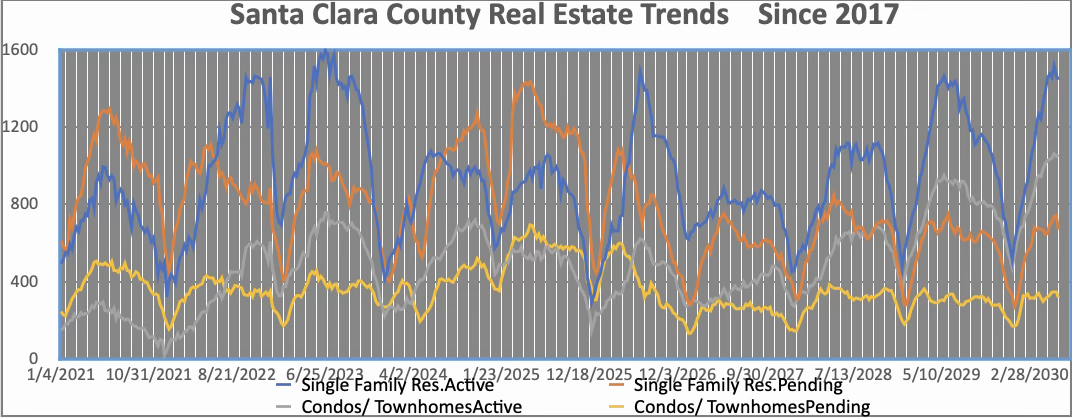
As an experienced realtor in Silicon Valley, I've watched several major downturns reshape this market over the years. Could Summer 2026 become another pivotal moment — the end of another bull run? Are we facing a potential 20% decline like many homeowners experienced in the second half of 2022?
As one of the top-producing groups at INTERO Real Estate, we work daily with both buyers and sellers across Santa Clara County and the greater Bay Area. We have a front-row seat to the supply-and-demand dynamics on the ground.
The current trend is clear: inventory has climbed to near-record highs while buyer demand has softened compared to the aggressive pace of previous years. The result is longer days on market, more price reductions, and lower final sale prices for homes that aren't strategically priced from the start.
Understanding the current conditions
To understand where we may be heading, it helps to examine what's driving today's market.
During the pandemic years of 2020 through early 2022, historically low mortgage rates created an unprecedented surge in buyer demand. Many buyers were able to qualify for larger loans, which pushed home values significantly higher across Silicon Valley.
Fast forward to 2026, and the landscape looks very different.
Mortgage rates remain elevated compared to the pandemic era. While rates have stabilized somewhat, affordability remains a major challenge for many first-time buyers. A household that could comfortably afford a $2 million home at 3% interest may find that same monthly payment only supports a significantly lower purchase price today.
At the same time, more homeowners are deciding to sell — some downsizing, some relocating, and others simply taking advantage of the substantial equity they've accumulated. When inventory rises faster than buyer demand, the market naturally shifts toward buyers.
Why today is different from 2022
Many homeowners remember the sharp correction of 2022. In some neighborhoods, values dropped 10% to 20% within a few months as rates rose rapidly. There are several key differences now.
First, inventory is rising gradually rather than suddenly. In 2022, the market was shocked as mortgage rates doubled in a very short window. Buyers stepped back overnight, leaving sellers scrambling.
Second, Silicon Valley employment remains relatively healthy. The tech sector has seen layoffs and restructuring, but overall household incomes remain among the highest in the nation.
Third, most homeowners hold substantial equity and low fixed-rate mortgages. Unlike 2008, most sellers aren't in financial distress — which reduces the chance of forced sales flooding the market.
Price corrections are certainly possible, but a severe market collapse remains less likely under current conditions.
What we're seeing on the ground
Statistics tell part of the story, but buyer behavior is usually the clearest signal. Across Santa Clara County, we're observing:
- Buyers are much more selective.
- Multiple-offer situations are less common except for truly exceptional properties.
- Homes that need updating are sitting longer.
- Price reductions have become more frequent.
- Well-prepared homes continue to attract strong interest and premium pricing.
Buyers are still active — they're just demanding value. A beautifully remodeled home in a desirable neighborhood can still generate real competition, while an overpriced or deferred- maintenance home may struggle to attract showings.
Advice for sellers
For homeowners considering selling in 2026, preparation has never been more important. The days of placing a sign in the yard and waiting for multiple offers over asking are largely behind us. Today's successful sellers focus on three things:
1. Strategic pricing
The market determines value — not the seller's expectations. Pricing too high results in fewer showings, longer exposure, and eventual reductions. A home that starts too high often sells for less than if it had been priced correctly from day one.
2. Property presentation
Professional staging, high-quality photography, pre-sale inspections, and minor repairs materially improve buyer perception. First impressions matter more than ever when buyers have options.
3. Strong marketing
Simply placing a home on the MLS is no longer enough. Effective marketing combines digital advertising, social media, email campaigns, agent-to-agent networking, open houses, and targeted outreach to qualified buyers.
Advice for buyers
Today's market presents opportunities buyers haven't had in years. Buyers now have:
- More inventory to choose from.
- Greater negotiating leverage.
- Increased opportunities for seller credits.
- More time to conduct due diligence.
The key isn't trying to perfectly time the market. Historically, calling the absolute bottom is extremely difficult — most buyers only recognize it after prices have already started moving higher. Focus instead on a home that meets your long-term needs and fits comfortably in your financial plan. For many families, the best opportunity isn't necessarily when prices are lowest, but when competition is reduced and negotiation is on the table.
So, is a major correction coming?
The honest answer: nobody knows with certainty. Real estate is shaped by interest rates, employment, consumer confidence, government policy, the stock market, and more.
Based on what we're seeing throughout Silicon Valley today, a slowdown is already underway. Inventory is rising, buyers are more cautious, and sellers must adapt. The data does not currently suggest a widespread 2008-style crash. A more likely path is normalization — prices softening in some areas while remaining stable in others. Neighborhoods with strong schools, convenient commute locations, and limited supply are likely to remain more resilient.
Final thoughts
Summer 2026 may well represent an important transition point for Silicon Valley housing. Whether it becomes a major turning point or simply a healthy adjustment remains to be seen. What's certain is that today's market is no longer the pandemic-boom market.
For sellers, success will require realistic pricing, thoughtful preparation, and professional marketing. For buyers, increased inventory and reduced competition may create some of the best opportunities we've seen in years.
Every neighborhood, city, and property type behaves differently. If you're considering buying or selling in Santa Clara County, Sunnyvale, San Jose, Cupertino, Mountain View, Palo Alto, or surrounding communities, evaluate local conditions rather than relying on national headlines. Real estate is local — and understanding your specific market is the key to making informed decisions.
Talk to Hoi
Want a read on your block?
Get a free, no-obligation valuation calibrated to recent comps within walking distance.
Request a valuation →